Friday, March 8, 2019

Wood Chips and Scorpions and Termites and Bugs

Why bring wood chips into your yard?  

Aren't you going to just get scorpions and termites and a lot of other nasty bugs?

Where do you get wood chips?

These are all really good questions.  I don't claim to be an expert on the subject, so I encourage you to do your own research. 

I like wood chips.  So here are a few answers.

Why chips?  

  • They decompose and approximate the fertile ground you will find under big trees in the forest.  They generate a lot of great nutrients that your trees benefit from.  When they are fully composed, the dark black soil that is generated can be put into your garden to great benefit.
  • It is really hot here in Arizona during 4 months of the year.  Your tree roots will love the cool micro-climate created by an over laying of chips.  In my opinion, your trees will thrive a lot better with chips over putting gravel around them.  (If you are planning to use chips and haven't planted your trees yet, I recommend you plant them a little bit on a mound so that when you do bring chips in  your trees will not be in a hole).
  • Chips keep the weeds down.  Gravel does not.
  • You will not have to water your trees nor the garden as much if they are surrounded by chips.  I do not put the trees on a regular clock timing system.  I water deeply when the trees need the water as I determine from a visual inspection of the trees and an inexpensive "water moisture meter" I bought at Urban Farms.  The "when" trees need water is dependent on a lot of factors that do not render themselves very well to the rigors of a time clock.  
What about scorpions and bugs?
  • If you have scorpions now, you will have scorpions after you get chips.
  • If you don't have scorpions now, the wood chips will not bring in scorpions or termites.  Do a search on the internet to verify this on your own, but here is a link to an Urban Farm pod cast on the subject.    The entire pod cast is about chips, but skip to minute 30 for a discussion about bugs.

Where do I get wood chips?
  • Watch for tree trimmers and ask them to dump in front of your house.
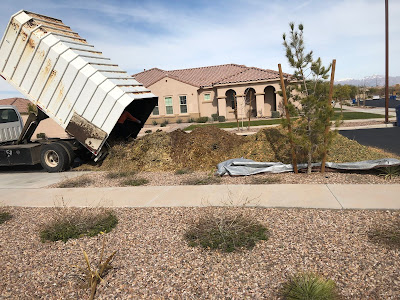
  • Sign up on getchipdrop.com  You order the chips; wait; then you receive the dump (the whole thing!).  Be cautious to specify "No Logs" and try to set it up so they have to call you before they dump a load or you might get 2 loads like I did!  You might coordinate with other members of the community ahead of time to get a load and distribute to different houses quickly instead of try to take the whole thing.  The following picture is a load I received in March 2019
I recommend you put a tarp to cover the gravel landscape.  It makes the cleanup a lot easier.

I now have 1' to 2' of chips everywhere in my yard where I have trees or bare dirt and about 1' in between my garden boxes.  It may have some flies for a day and "steam" a day or two.  After that it starts to flatten out as it decomposes slowly.


This is about the 3rd load of chips I have had to my yard.  I am pleased with the result.  


Wednesday, October 24, 2018

Soil Blocker & Light Tray

With Marta Anderson's help and guidance I started my first 3-tier florescent light indoor seed sprouting and starting system and employed the "Soil Blocker" method to create the individual cells.  I am really happy with the results so far and sincerely thank Marta for the time she spent teaching me and hope that in the future the Eastmark Garden Club can benefit more from her knowledge.

Here is a run down.

BLOCKING ( I took most of the following from “The New organic Grower”, Eliot Coleman)
The blocking mix is different than a potting mix because the blocking mix needs extra fibrous material to allow it to be formed into a paste suitable for making blocks.  It also needs good water holding capability.  It is a mixture of peat, sand, soil and compost.  Go to Johnny’s Seed to watch a video to explain it.  Look under “Hand Held 4-cell soil blocker”.

Here is a link to the video at Johnny's Seed =>  Click here

SEED STARTING FORMULA:  (Bucket => about the size of a mop bucket)  Using the following batch formula, it created enough soil to furnish 250 cells and 10 each 4” pots and had one 5-gallon bucket of starter left over.


WATER: About 1 part water to 3 parts mix.  For successful block making the mix will be wetter than you would use for flats.  The most common mistake is to try to mix it too dry.

GERMINATION: Give the seeds very little cover if any.  Larger seeds do get some cover.  Cover with seran warp until sprouted (ie do not keep watering).  For most crops the temperature needs to be 70 to 75 degrees.  Asparagus, cucumber, eggplant, melon, pepper and squash needs 75 to 80 degrees.

GROWING: Keep the water level high using a mist sprayer or take the trays out to go water someplace you don’t mess up the room. 

COST

The picture above shows the final result: 250 individual cells and 10 pots.  After placing the seeds, I noted carefully which cell had which seed, and covered the entire tray with saran wrap.  Below is my record of what I planted and the results.  


Here are some pictures 6 days after planting.


Within a week of planting, everything in the light system came up and was growing like crazy except for the Ithaca lettuce and the Parsley.  I understand the Parsley, but I think the Ithaca lettuce seed is no good.


This has been a roller coaster ride of emotions!  Do I water or not water?  Do I transplant outside or not transplant?  What happens if I leave them to grow under the lights?  Will they dampen off and die or grow large plants?  How long do I experiment with this before I lose the opportunity to put them in the ground?

By day 8 everything is either in 4" pots or has been put into the garden except for some lettuce, turnips and sweet pea flowers and I am ready to start another batch!

I know if I had planted the above directly into the garden, I would have used a lot more water, worked a lot harder, and would have had to wait a lot longer.  There are a lot of environmental factors going on under the ground to prohibit seed sprouting that are overcome by the light system that I am sure I would not have had as much success with direct sowing and would have had to wait a lot longer for the results.

After a few weeks, I lost almost everything I had started under the lights in the last experiment.  They grew long and spindly then dampened off.  So in terms of producing something in the garden, this was a failed experiment.  In terms of what I learned, it was a complete success.  So I tried again.

EXPERIMENT #2 This time I cut the Superphosphate in half.  I had better results.  Here are some plants I started 17th of January.  We have had some hard freezes, but the weather is warming up and I think I will be ready to plant next week (28 February).  I expect good results.


After I figured our freezes were over, I transplanted to the garden.  Within a week nearly everything was dead!

What did I do wrong?

Marta told me I had skipped a very important phase:  The plants were Sun Burned!  I needed to have "Hardened Off" the plants to get them accustomed to the sun even though the days were mild.  Hardening off is a process of slowly getting the plants used to being outside.

In conclusion, I have a LOT more to learn and to develop a routine that works best for me.  

A year has past since I started this blog.  I have used the light tray/blocker several times successfully and am happy with it.


Sunday, May 13, 2018

Ro Reed Garden Tour

Ro gave a tour of her garden.  She has some really nice ideas.


Here are some shots of her "Fairy Garden"


They also sport a "Desert Tortoise" run.


Tuesday, August 8, 2017

Meetings

The Eastmark Garden Club meets on the 2nd Saturday of each month at "The Mark" (TYPICALLY).  Watch for updates on the "Eastmark Garden Club" facebook page.

Our goal is to have a garden tour at the home of one of the garden club members each month.  Watch for updates on the "Eastmark Garden Club" facebook page.

Sequoia Pathfinder School Service Project

A few members of The Eastmark Garden Club met Saturday August 5 and among the items discussed was an opportunity to help the Sequoia Pathfinder School organize a school garden following the suggested outline in "Az Gardens for Learning" book produced by the Western Growers Association that can be read at this link:  Az Gardens for Learning

The idea did not really take off at that time, however I have not given up on the idea.  Here are my plans.


  1. Perfect my ability to grow starts under lights inside
  2. Learn how to vermicompost in a bin
  3. Identify a few persons willing to spend a lot of hours initially to work with the school to set up the program and gather materials and then a few people who can spend a few hours each month to ensure the program is working.  A teacher has to be a main force and parents from the school must be present.
8 March 2019 I am still working on #1.  

Please contact me if you want to contribute to this project.
Find me on the Eastmark.com community directory.
Wallace Haws

Monday, July 17, 2017

Jane the Rose lady

Jane, a member of the Eastmark Garden Club hosted a Club Garden tour 15 July 2017.  Here are some notes:
Jane has a great start for a pretty impressive Rose Garden.  Unfortunately, she wasn't able to plant them at the ideal time, but took a chance anyway.  She set up garden boxes with block from Home Depot, filled with Kellogg Planting/Bedding soil from Home Depot and a sprinkler system for watering.

She advised a lot of compost, avoid commercial fertilizers, use Fish emulsion and frequent waterings.

It is important to 'Dead head' the roses to keep them from going to hip.  You will have a longer and better rose production.

Aphids: Use a hand sprayer with water, oil, dish soap and spray in later afternoon.

Mesa Community College is the home of the East Valley Rose Society.  Jane encourages all of us to visit their incredible Rose garden.

A picture is worth a 1000 words, so here is a video report of our garden tour!


Saturday, June 3, 2017

Bolstad Garden Tour

A picture is worth a thousand words.  Here is a movie showing the tour we had this morning at the Bolstad home.  A big thank you to the Bolstad family for their hospitality.

Tuesday, May 23, 2017

INSANITY

Insanity: doing the same thing over and over again and expecting different results. - Albert Einstein

You might consider keeping track of what you do in your garden.  If you don't you may be INSANE as defined above and missing opportunities.

KEEP TRACK OF WHAT/WHEN YOU PLANT
One way to do that is using a spreadsheet.  Keep track of what you plant on a calendar.  Create symbols representing how you plant.  Insert comments for more detailed notes.

Here is a link to a sample spreadsheet:

                          PLANTING SPREADSHEET

Be sure to click "Open with" google sheets so you can read the comments

Sunday, May 7, 2017

Purpose and Goals

The Eastmark Gardening Club was approved by Eastmark HOA 26 April 2017

We believe it is important each family produce some food within the confines of their own lot to somewhat stabilize availability of ready healthy food and to preserve seeds in the hands of people. 

We also believe gardening includes growing flowers or other plants that are pleasing to the eye and will gladden the heart.  

The Eastmark Garden Club has these goals:  G--E--S

Encourage as many people as possible to:
G =  Grow a garden and produce as much of their own organic food at home in home gardens (in-ground, pots, hydroponics, etc) and grow flowers to beautify homes and gladden the heart.  Particular attention will be given to small urban yard gardens to compliment the limited space and growing conditions of the community that we live in.  
E =  Educate club members so they have the skills to be successful
S =   Save seeds, particularly those indigenous to the Sonoran Southwest and Exchange seeds with club members and Share ideas.

METHODS:
·       Education:  Provide information where people can go to get educated on their own; invite speakers; produce blog posts, etc
·       Collaboration: Provide means for people to exchange ideas and encourage one another in their efforts to garden and save seeds.
·       Seed Exchange: Coordinate efforts to save seeds of as many varieties as possible and share with as many people as possible.

TOOLS:
·       Create a blog to post educational material, results of experiments by garden club members and links to education sites
·       Create a Facebook page so Garden Club members can interactively ask questions, receive comments and post successes and failures

MEETINGS:
·       Most information shared by the Eastmark Gardening Club will be via social media instead of face to face meetings.  However the following meetings are envisioned.
o   Monthly meetings/tours of different club member gardens.  They can demonstrate what they are going, share ideas, get advice, etc
o   Non-regular meetings where specialist are invited to speak.
o   Spontaneous meetings among garden club members

CLUB MEMBERSHIP:
·       Anyone can join, but residents of Eastmark will be the primary target
·       Members ‘join’ the ‘club’ by requesting their name, email and telephone # be added to the club roster and voluntarily participating in the Facebook page, formal meetings, sharing information, etc 
·       Level of participation in the club is totally voluntary, dependent on the person’s time, resources and interests and can range from a casual review of the blogsite and facebook to active participation in the seed exchanges, in seed diversity experiments, helping to organize club meetings, speakers, expos, etc
·       Nothing is purchased or sold by the club, so there will be no membership dues or fund raisers.

COMMUNITY GARDEN
·       The Eastmark Garden Club is not a typical “community garden” because of all the challenges and problems otherwise associated with real estate, finances, management, security, etc.  The success of a typical community garden usually depends on the efforts of a small handful of people who do most of the work.  It also detracts from the goals of the Eastmark Gardening Club.


·       The Eastmark Garden Club might be considered a "Virtual Community Garden".  Every family will have the opportunity to produce something within the confines of their own lot where success (rewards) or failure (learning experiences) depends entirely on the family involved.  Because the garden is just outside their kitchen window and will be seen every day, the garden is central to the family activities and won’t be forgotten.  Collectively, all the family gardens in the Eastmark Garden Club constitute the “Community” garden which is shared through the blogsite, facebook, visits by club members to individual family gardens, seed exchanges, sharing produce, etc.

Friday, April 28, 2017

Container Gardening

Container Gardening is a great alternative for small urban lot gardens.


Container Gardening requires special considerations that are different than in-ground gardens.

Here is a list of great advice found on Native Seeds:  CONTAINER GARDENING

We look forward to some great ideas from members of the Eastmark Gardening Club!!

Thursday, April 27, 2017

Seed Library

WHAT IS A SEED LIBRARY?

Just as our “Community Garden” is actually located on the individual lots of the Club members, our “Seed Library” can be thought of as the collective efforts of Club members to share and save seeds among Club members.  Each Club member will have his own ‘library’ hopefully in a box or something that he/she can easily carry to seed exchanges.  Collectively we will attempt to expand our collective diversity of heirloom seeds native to our area and share among the members.

HOW DOES THE LIBRARY WORK?
If I grow Swiss Chard, I can set aside one or two plants, let them go to seed and share these seeds with someone else for seeds that I don’t have but want.  I advertise on the blog or face book both my need and the seed I have.  Other members can respond.

Since the process of letting a plant go to seed can take much more time than just growing and harvesting, it takes both more time and more garden space to accomplish it.  A Seed Library has the potential of expanding seed production and maintaining seed purity.  If one member agrees to let one plant go to seed, he will typically produce enough seed to supply several other members.  If several members each let a different type plant go to seed and they plan ahead who will produce what, seed production is greatly expanded.


Anyone with seeds to share can bring them to Club meetings where a seed exchange can occur.  

Potentially, seeds and particularly a wide diversity of seeds can become a valuable trade commodity.

Wednesday, April 26, 2017

Planting Charts

The following planting charts are specific for this area:

                     ZEB PEARCE PLANTING CHART

                     NATIVE SEED PLANTING CHART

                     URBAN FARM PLANTING CALENDAR

                     UNIVERSITY OF ARIZONA PLANTING GUIDE

                     FLOWER PLANTING GUIDE FOR LOW DESERT

ZEB PEARCE:  Zeb Pearce was a man that owned a Co-op store in downtown Mesa (Sirrine & 1 place) many years ago.  It was a great place to shop for garden and farm.  They produced a very good planting chart. Somehow I was able to save one from so long ago.

NATIVE SEED PLANTING CHART:  NATIVE SEED.ORG is a company in Tucson with a farm in Patagonia Arizona that specializes in heirloom seeds native to the Sonoran Desert.  This is a good web site to visit.

URBAN FARMS PLANTING CALENDAR:  The Urban Farms is a gardening store in Phoenix, Arizona that is a great source for trees, seeds and planting supplies.  They also teach a course on vermacomposting.

HAWSIENDA EXPERIMENTAL FARM PLANTING CHART:
I compiled information from the above planting charts into one chart that I am using in Mesa, Arizona. 
                  HAWSIENDA PLANTING SPREADSHEET

Wood Chips and Scorpions and Termites and Bugs

Why bring wood chips into your yard?   Aren't you going to just get scorpions and termites and a lot of other nasty bugs? Where do y...